18 min read
Framer vs Lovable: Website or Web App in 2026?
Framer and Lovable can both turn a prompt into a published website. In 2026, that surface-level similarity makes them look like direct competitors. They are not.
Framer is primarily a visual website builder. It gives designers direct control over layouts, typography, breakpoints, interactions, CMS content and publishing. Lovable is a full-stack AI development platform capable of generating an editable codebase, authentication, databases, storage and backend logic.
The right choice therefore depends less on which platform is “better” and more on what you are trying to build.
To make the comparison more concrete, we gave both AI agents the same detailed brief for a fictional B2B logistics company. We evaluated the initial desktop and mobile designs, then asked each agent to perform the same set of precise visual corrections. We also compared their manual design tools, features, code access, CMS, SEO and pricing.
The short answer is:
Choose Framer for design-led marketing websites and content-driven sites. Choose Lovable for functional web apps, SaaS products and projects where backend functionality or code ownership matters.
However, our agent test produced a less predictable result: Lovable generated the slightly better first design, despite Framer being the more design-focused platform. Neither result was strong enough to publish without substantial refinement.
Framer vs Lovable at a glance
Category | Framer | Lovable | Edge |
|---|---|---|---|
Primary strength | Design-led and content-driven websites | Full-stack web apps and SaaS products | Depends on the project |
Manual visual control | Granular canvas control over layers, components and breakpoints | Visual editing for common changes, with code available for deeper control | Framer |
Initial AI-generated design | 5.5/10 in our test | 6/10 in our test | Lovable, narrowly |
Following our visual correction | Completed all four changes with inspectable breakpoint logic | Completed all four changes successfully | Framer, narrowly |
Interactions and motion | Native visual tools for website animations and effects | Usually implemented through generated components and code | Framer |
CMS | Native collections, references, detail pages and content-editor roles | Requires a database, external CMS or custom content interface | Framer |
SEO | Mature website-specific controls and publishing workflow | SSR, technical audits, Search Console guidance and Semrush research | Framer for marketing sites |
Code and portability | Custom code supported; full-site export documentation is contradictory | Editable codebase, download, GitHub/GitLab sync and external deployment | Lovable |
Backend functionality | Primarily depends on external services | Built-in database, authentication, storage and backend functions | Lovable |
Entry paid price | Basic starts at $10/month | Pro starts at $25/month | Framer for a simple website |
Framer and Lovable are built for different jobs
At first glance, both platforms follow a similar workflow: describe what you want, let an AI agent generate it and publish the result. The similarities become much smaller once the project needs to be edited, expanded or maintained.
Framer combines a visual design canvas with a managed website platform. Designers can directly select and edit layers, create reusable components, control responsive behaviour and build interactions. Its native features are centred on websites: pages, CMS collections, forms, localization, analytics, redirects, staging and hosting.
Lovable works more like an AI-powered software development environment. It generates an editable application codebase and can build both the frontend and backend. Its built-in Cloud platform includes a database, authentication, storage, realtime data and serverless functions, while integrations connect projects to services such as Supabase, Stripe and Resend.
A useful way to understand the difference is:
Framer is better suited to building the website that markets a SaaS product. Lovable is better suited to building the SaaS product itself.
This is not an absolute limitation. Framer can connect to APIs and external services, while Lovable can produce conventional marketing websites. But using either platform outside its core strength usually introduces more complexity or requires greater technical involvement.
The practical question is therefore not simply “Which platform is better?” It is whether the project is primarily a public-facing website or a functional application where users sign in, store data and complete workflows.
How we tested the Framer and Lovable agents
We created a fictional B2B logistics platform called Silo and gave both agents the same initial brief. It specified:
the page structure and content;
a warm, restrained colour palette;
Instrument Serif for headings and Manrope for body and UI text;
a maximum border radius of 8px;
responsive desktop, tablet and mobile layouts;
a hero with an operations dashboard instead of a generic stock image;
feature cards, customer proof, metrics, a final CTA and a footer.
The prompt was deliberately more detailed than “make me a SaaS landing page,” but we did not provide a reference image or prescribe an exact composition. This allowed us to test how each agent interpreted the same visual direction.
After assessing the initial results, we sent both platforms one refinement prompt containing four measurable changes:
Use 24px horizontal padding on smaller screens.
Stack the hero buttons at full width on mobile, with a 12px gap.
Align the top of the Operations Board with the top of the hero headline on desktop, rather than the eyebrow.
Give the feature cards square corners and 32px padding, while preserving the smaller radii used by the dashboard and buttons.
We assessed initial design quality based on hierarchy, composition, typography, spacing, consistency and responsive behaviour. A score around 5 represented a functional but visually average result. Scores of 8 or above were reserved for polished work that could reasonably be published with only minor adjustments.
For the refinement prompt, we evaluated whether each instruction was completed, whether the changes were visible across the relevant breakpoints and whether the agent altered anything outside the requested scope.
Limitations of the test
This was a practical comparison, not a scientific benchmark. We tested one landing page, one initial generation and one targeted correction on each platform. Different prompts, reference images, models or additional iterations could produce different results.
Framer used Sonnet 5 with Light reasoning. The Lovable interface used in our test did not disclose an equivalent model or reasoning setting. We were therefore comparing the complete platform experiences, not the performance of two identical underlying models.
The test was conducted on August 18, 2026. Both platforms are developing quickly, so specific agent behaviour and features may change.
GYFT curates Framer templates, and we know Framer considerably better than Lovable. To reduce that potential bias, both platforms received the same instructions and number of iterations, and we evaluated the published desktop and mobile outputs rather than relying only on what each agent claimed to have changed.
Initial design quality: neither result was ready to publish
Lovable produced the stronger first draft, but the difference was small. Both pages were functional, responsive and internally consistent. Neither demonstrated the level of composition, typography or detail expected from a professionally designed landing page.
Lovable: better composed, but still generic — 6/10
Lovable’s result felt slightly more complete and editorial. It created a clearer transition into the feature section, used a more substantial Operations Board and presented the customer story with stronger contrast between the testimonial and supporting data.
The page also had a more deliberate rhythm. Light content sections were interrupted by a dark metrics band, while the large quotation created a useful change in scale further down the page.
However, the design remained generic. Most of the interface relied on bordered white cards, the typography lacked refinement and the page had no distinctive visual idea beyond the serif-and-sans-serif combination specified in the prompt. It looked like a competent AI-generated SaaS landing page rather than a considered brand experience.
The mobile version remained usable and did not show major layout failures, but the initial hero actions and dense Operations Board still required refinement.
Lovable initial design score: 6/10.
Framer: clean, but underdeveloped — 5.5/10
Framer’s result followed the requested visual system and produced a coherent responsive page. The typography, colours and restrained border radii were broadly consistent, and the page included the main requested sections.
The execution was weaker at the level of composition. The hero left a large amount of underused space, the Operations Board felt small relative to the available canvas and the feature section moved directly into three generic cards without a strong transition or headline. Several sections appeared to be isolated content blocks rather than parts of a continuous visual narrative.
Typography and interface text also became very small in places, particularly in the dashboard, feature cards and mobile layout. The page was clean and functional, but it felt closer to a styled wireframe than a finished marketing website.
Framer initial design score: 5.5/10.
Was the weak design caused by the prompt?
Partly, but not entirely.
The brief defined the visual ingredients while leaving the precise art direction open. A reference image, more explicit typographic scale or prescribed composition could have improved both results. Framer's own agent guidance recommends providing visual references and generating one section at a time when greater control is required.
However, the prompt was detailed enough to support a professional result. It specified the purpose, structure, typography, palette, component style and responsive behaviour. Each agent still had to turn those constraints into hierarchy, rhythm and visual interest.
The fact that Lovable produced a slightly stronger composition from the same brief also suggests that the prompt was not the only limitation. Lovable won this round, but it produced the better of two average designs—not an excellent one.
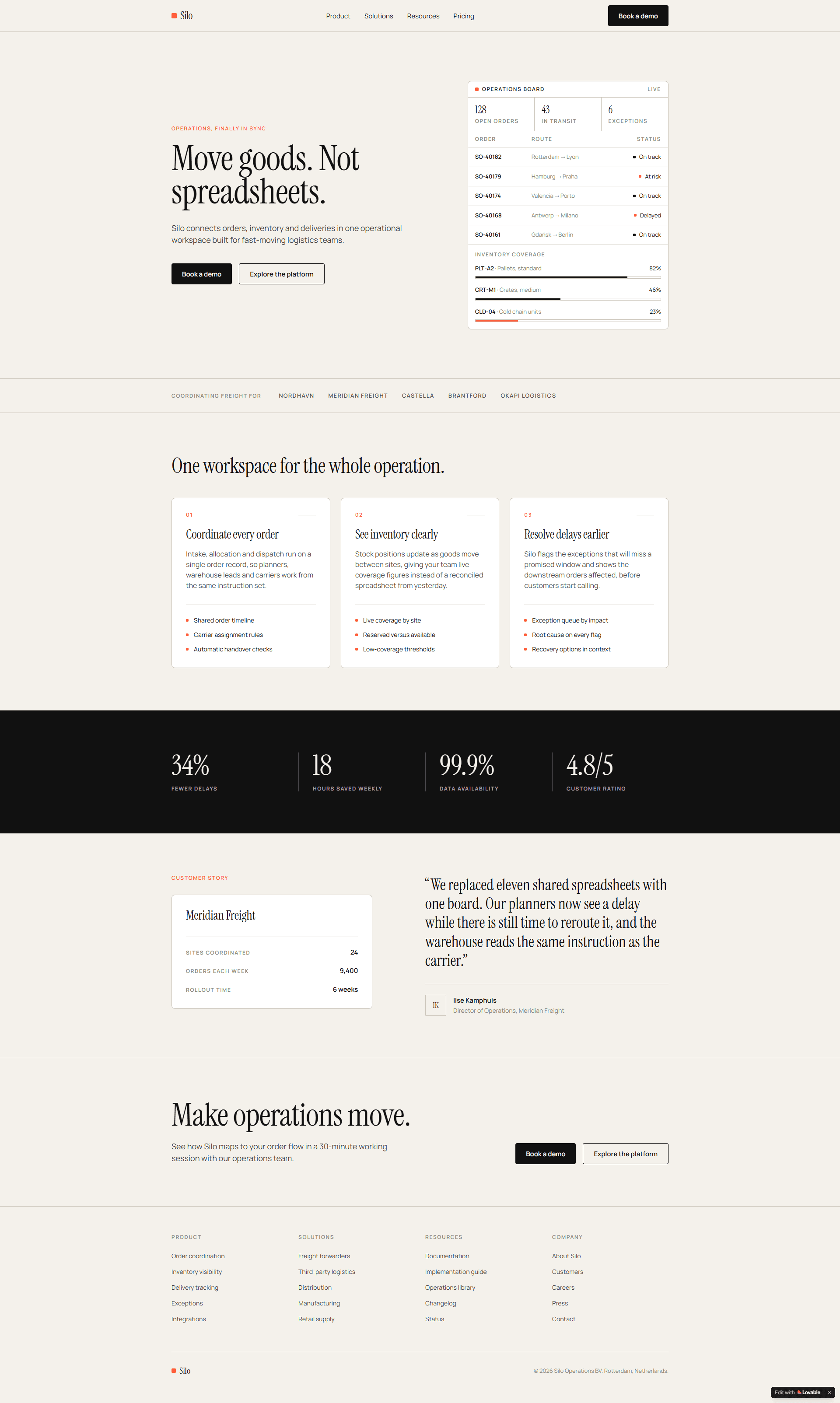
Lovable’s initial result presented a fuller dashboard, stronger section transitions and a more developed customer story. We rated its visual quality 6/10.
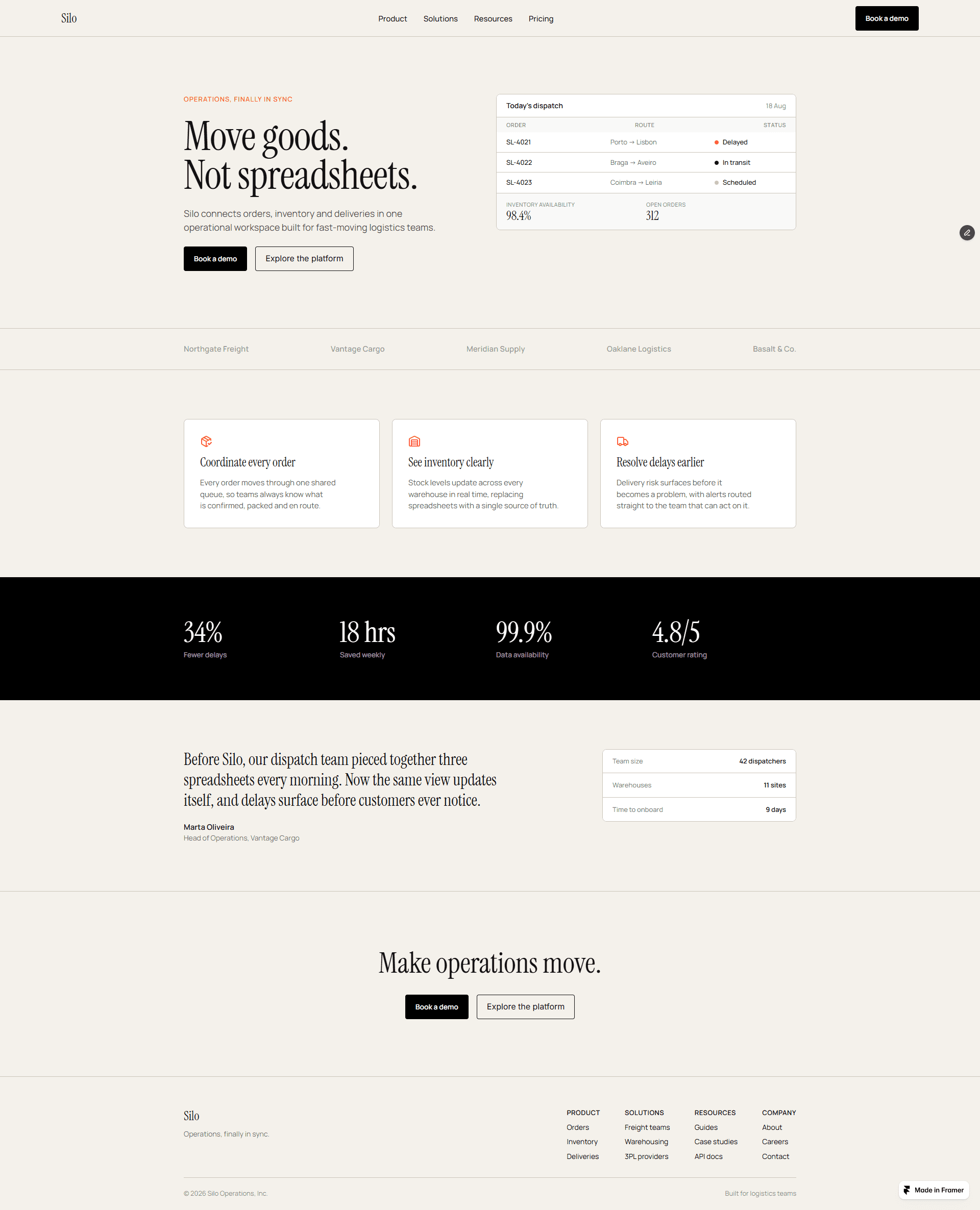
Framer’s initial result was clean and consistent but more sparse, with smaller interface elements and weaker transitions between sections. We rated its visual quality 5.5/10.
Which agent followed precise visual instructions more reliably?
Both agents performed better when the task changed from open-ended design to a set of measurable visual corrections.
This distinction matters. Generating an attractive design requires subjective judgment. Changing a known breakpoint, alignment, radius or spacing value is a more objective test of whether an agent understands and executes instructions accurately.
Lovable completed all four requested changes
Lovable changed the hero buttons to a full-width vertical stack on mobile, aligned the Operations Board with the hero headline on desktop and updated the feature cards with square corners and 32px padding.
The agent noted that the mobile header and section padding were already set to 24px, so it did not unnecessarily rebuild that part of the page. The published result broadly matched all four instructions without obvious changes to unrelated content.
Lovable visual-instruction score: 8/10.
Framer also completed all four changes
Framer created explicit breakpoint behaviour for screens between 420px and 767px while preserving the existing layout below 420px. Both ranges used the requested 24px horizontal padding.
The hero buttons became full-width with a 12px gap only on mobile, while desktop and tablet retained the horizontal layout. The Operations Board was aligned with the headline rather than the eyebrow, and the feature cards received square corners and 32px padding. The smaller radii used by the dashboard and buttons were preserved.
The changes could be inspected directly across the desktop, tablet, compact and phone canvases, making it easier to verify that the agent had not only changed the visible preview but also implemented the intended responsive logic.
Framer visual-instruction score: 8.5/10.
Framer wins this test narrowly
Both agents successfully completed the correction. Framer receives a small advantage because its breakpoint implementation was more explicit and easier to inspect, not because Lovable failed the task.
The result also suggests that both agents are currently more reliable at executing concrete, measurable instructions than making broad visual decisions. However, one correction prompt is not enough to conclude that Framer’s agent will be more dependable across every project or type of request.
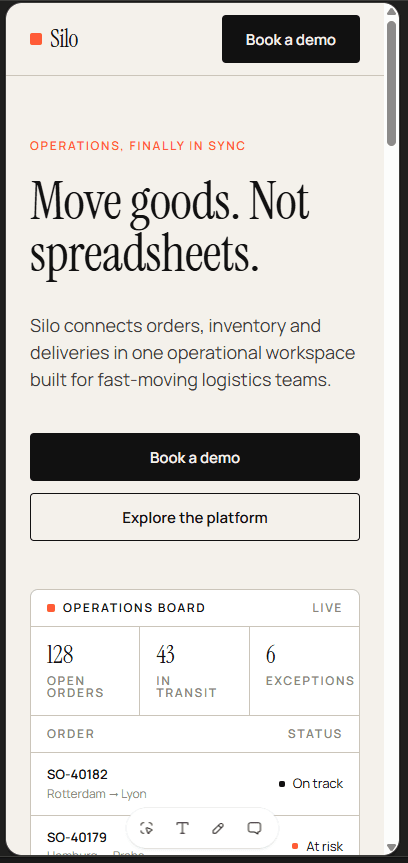
After the second prompt, Lovable stacked the hero actions at full width below 424px while preserving the surrounding mobile layout.
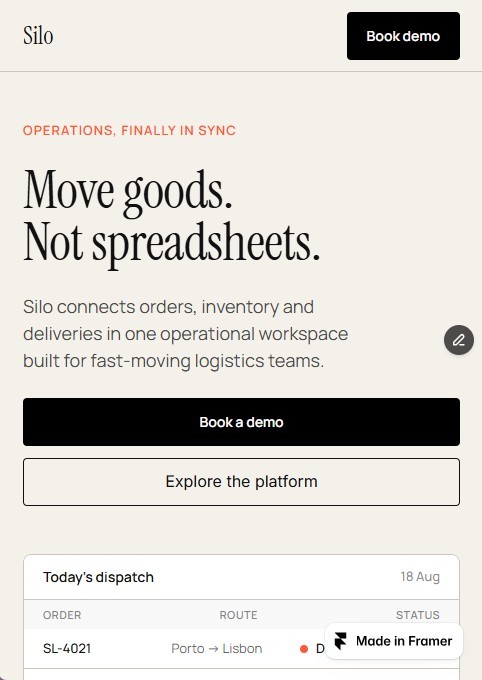
After the second prompt, Framer stacked the hero actions at full width below 420px and preserved the responsive dashboard beneath them.
Visual control after AI generation
Framer’s greatest advantage in our test was not what its agent generated, but how easily we could refine the result afterwards.
Everything created by the agent became editable on Framer’s regular canvas. We could select individual layers, enter exact values, adjust components and inspect desktop, tablet, compact and phone layouts without sending another prompt or spending more AI credits.
Lovable also supports direct visual changes to text, images, colours and spacing. For deeper control, users can edit the generated code or continue through GitHub or GitLab. This offers developers considerably more technical flexibility, but designers without frontend experience have less direct control over layout structure and responsive behaviour.
The distinction is therefore straightforward:
Framer provides stronger visual control.
Lovable provides stronger control over the underlying code.
For design-led websites, Framer offers the more accessible refinement workflow. For applications that developers will extend, Lovable’s editable codebase is the more valuable form of control.
Website and web app features
Framer provides most of the features needed for a modern marketing website in one environment: responsive pages, reusable components, animations, forms, CMS collections, localization, analytics, redirects, staging and managed hosting.
Custom code, React components and third-party services can extend those capabilities. However, features such as user accounts, persistent application data, permissions and complex business logic normally depend on external systems. Framer can support them, but they are not the platform’s native focus.
Lovable is considerably stronger for functional products. Its built-in Cloud platform includes a database, authentication, storage, realtime data, edge functions, scheduled jobs, secrets and logs. It can also generate integrations for services such as Stripe, Resend and Supabase directly from the project chat.
That makes Lovable better suited to dashboards, customer portals, marketplaces, internal tools and SaaS MVPs. These generated features still require testing—particularly authentication, database permissions and payments—but Lovable removes much of the initial full-stack setup.
For a conventional website, Framer offers the more focused workflow. When users need to sign in, store data or complete product-specific workflows, Lovable has the stronger native foundation.
Code access, ownership and portability
Lovable has a clear advantage for teams that want a conventional code workflow. Projects generate an editable codebase, and Git sync is available for GitHub and GitLab. Developers can work locally, use version control and deploy the project outside Lovable. Paid plans also allow users to download the codebase directly.
Framer supports custom CSS, JavaScript, React code components and external coding agents. However, it remains centred on its visual editor and managed publishing environment rather than a conventional repository-based workflow.
Framer’s documentation contradicts itself on site export
Framer’s official documentation currently provides two incompatible answers about exporting a complete website.
One help article, updated on August 7, 2026, states that Framer does not provide HTML or static-site exports. Another article, updated on the same date, says users can download a site’s HTML, CSS, JavaScript and assets and move them to another hosting provider.
The documentation does not explain how these statements can both be correct. If self-hosting or complete site-output portability is essential, confirm the current process directly with Framer before committing to the platform.
Even if complete output export is becoming available, Lovable still offers the clearer path to editable application code, Git-based collaboration and external deployment.
CMS and content management
Framer is the stronger option for content-driven websites. Its native CMS supports structured collections, references between collections, reusable detail pages and visual connections between content and components. Dedicated content-editor roles allow non-designers to update material without changing the page layout.
This makes Framer well suited to blogs, case studies, directories, team pages and resource libraries. Its CMS is less flexible than a dedicated enterprise platform such as Contentful or Sanity, and collection and item limits depend on the selected plan, but the workflow is integrated and accessible.
Lovable does not provide an equivalent purpose-built website CMS. Content can be stored in its database, managed through a custom admin interface or pulled from an external service such as WordPress. This offers greater flexibility for application-specific data, permissions and workflows, but requires more setup.
For editorial content maintained by marketers or non-technical teams, Framer is the easier choice. Lovable becomes more attractive when the content behaves like application data rather than a conventional website collection.
SEO and performance
Framer provides a mature SEO workflow for marketing and content-driven websites. It automatically generates sitemap.xml and robots.txt, while its SEO controls cover metadata, indexing, semantic elements, redirects, image alt text and CMS pages. Custom code can also be used for structured data and other advanced requirements.
Lovable’s SEO capabilities are stronger in 2026 than many older comparisons suggest. Its SEO and AI search review checks metadata, sitemaps, robots.txt, canonical tags, semantic HTML, structured data, accessibility and mobile usability. It also includes Search Console guidance and Semrush-powered research.
New Lovable projects created from May 13, 2026 use TanStack Start with server-side rendering. Older React and Vite projects rely on crawler-focused pre-rendering but can be upgraded.
There is an important caveat: Lovable states that metadata, sitemaps and other SEO elements may not always be generated initially. Users may need to run a review and ask the agent to create or repair them, which can consume additional credits.
Framer remains the more coherent choice for an ongoing content and SEO programme because its CMS and publishing workflow are designed around crawlable website pages. Lovable now provides credible technical SEO foundations, particularly for a platform focused on applications.
We did not run a controlled Core Web Vitals test, so we would not declare a performance winner. On both platforms, real-world performance will depend on the generated layout, media, scripts, integrations and ongoing implementation decisions.
Pricing and the cost of iteration
Framer’s advertised paid plans start at $10 per month for Basic and $30 per month for Pro. Basic includes 1,000 monthly AI credits, while Pro includes 3,000. Additional editors, localization, A/B testing, advanced hosting and higher CMS limits can increase the total cost.
Lovable Pro starts at $25 per month, or the equivalent of $21 per month with annual billing, for 100 subscription credits. Business starts at $50 per month. Paid plans also receive daily build credits and separate monthly grants for Cloud and AI usage.
Lovable uses credits not only to build and modify projects but also for its hosted backend and AI features running inside published applications. Costs can therefore increase with both development activity and application usage.
What our test consumed
Platform | Initial generation | Visual correction | Total |
|---|---|---|---|
Framer | 146 credits | 77 credits | 223 credits |
Lovable | 3.20 credits | 1.50 credits | 4.70 credits |
Framer used Sonnet 5 with Light reasoning for both prompts. The initial generation took 5 minutes 47 seconds and the correction took 2 minutes 24 seconds, for a total of 8 minutes 11 seconds. Lovable did not expose equivalent model or reasoning information in our test.
The raw credit totals are not directly comparable because each platform defines and prices credits differently.
Our Framer workflow consumed 44.6% of the Free plan’s 500-credit monthly allowance, 22.3% of Basic’s allowance or 7.4% of Pro’s. The Lovable workflow used almost one full daily grant of five credits, or 15.7% of the Free plan’s maximum 30 monthly build credits.
On Lovable Pro, 4.70 credits represent approximately $1.18 of a 100-credit, $25 monthly allocation. This is an estimate of the plan value consumed, not a separate charge for the two prompts.
For a simple website, Framer is generally cheaper and easier to budget. For a web app, the subscription prices are not directly equivalent: Lovable may replace separate frontend, backend, authentication and deployment setup, but usage-based infrastructure and third-party services can add variable costs.
Which platform should you use?
Choose Framer if you are building:
a startup or SaaS marketing website;
a portfolio or agency website;
a landing page or campaign site;
a blog, case-study library or content hub;
a visually distinctive website with detailed responsive art direction;
a site maintained by designers, marketers or content editors.
Framer is the better choice when the public-facing website is the primary product and visual presentation matters more than backend functionality.
Choose Lovable if you are building:
a SaaS MVP;
a customer portal or dashboard;
an internal tool;
a membership product;
a marketplace or transactional workflow;
an application with authentication, user-specific data or backend logic.
Lovable is the better choice when users need to sign in, store information or complete workflows—and when developers may eventually extend the project through a conventional codebase.
Consider using both when:
A product needs both a highly polished marketing website and a functional application. The public site can be built in Framer, while the authenticated product runs in Lovable on a subdomain such as app.example.com.
This introduces additional complexity around design consistency, analytics and maintenance, so it is most appropriate when the two parts have clearly different requirements.
Final verdict
Framer is the better platform for design-led websites. Lovable is the better platform for functional web applications.
Our agent test does not change that conclusion, but it adds an important qualification. Framer should not be chosen because its AI automatically produces better design—it did not in our test. Its advantage is the visual control, CMS and website workflow available after the first generation.
Similarly, Lovable should not be chosen because it generated a slightly better landing page. Its real advantage is the ability to build frontend and backend functionality within an editable, portable codebase.
Neither agent removed the need for design judgment. Both followed concrete corrections more reliably than they created a strong visual direction from the original brief.
Choose Framer when you need to design and maintain a polished public-facing website. Choose Lovable when you need to build a working product with users, data and application logic.
Frequently asked questions
Is Framer better than Lovable for websites?
Framer is generally better for marketing, portfolio and content-driven websites. It offers stronger visual editing, responsive control, interactions and native CMS workflows. Lovable is more suitable when the website also requires application logic, user accounts or a database.
Is Lovable better than Framer for web apps?
Yes. Lovable includes authentication, databases, storage, backend functions and integrations within the same development workflow. Framer can connect to external services but is primarily designed for publishing websites.
Which platform produces better designs with AI?
In our test, Lovable’s initial design scored 6/10 and Framer’s scored 5.5/10. Lovable produced the slightly stronger composition, but neither result was close to publish-ready. Reference images and additional iterations could improve both.
Which is better for SEO?
Framer offers the more coherent workflow for content-led SEO websites because of its CMS and publishing tools. Lovable now provides credible technical SEO foundations, including SSR for new projects, automated audits, Search Console guidance and Semrush-powered research.
Can you export code from Framer and Lovable?
Lovable supports editable code, direct downloads on paid plans, Git sync and external deployment. Framer’s official documentation currently gives contradictory answers about exporting a complete site, so users who require self-hosting should verify the current process directly.
Which is cheaper?
Framer Basic starts at $10 per month, while Lovable Pro starts at $25 per month or $21 with annual billing. Framer is generally cheaper for a simple website. A web app requires a broader comparison because Lovable can also provide backend infrastructure and application functionality.
Sources

Try Systeme.io
Your website is only the beginning.
Take your Framer site further with funnels, email marketing, automation, bookings and more.


AFFILIATE PARTNER